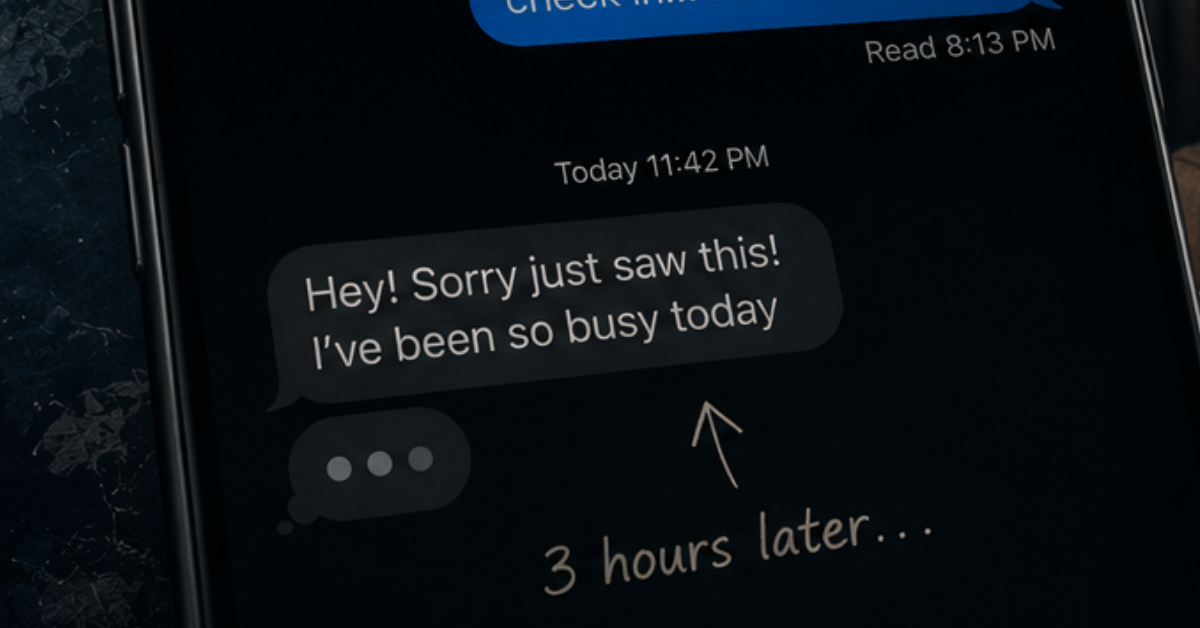
You send a normal text. Nothing dramatic. Nothing clingy. Nothing that should turn into a whole internal event. Then the reply does not come.
At first, you tell yourself they are probably busy, but then you check your phone again, and realize they still didn’t respond. Granted they could be busy but who is that busy where they can’t send a text.
Next thing you know you are rereading what you sent, and staring at the thread like there is some hidden answer in there you missed the first time. The longer the pause goes on, the less neutral it feels. Now you are not just waiting for a reply, you are trying to figure out if something changed.
This is the part people shame themselves, they say, “I’m being dramatic or I’m too sensitive or I’m too attached to my phone.” But the phone is usually not the issue.
The issue is usually how quickly uncertainty can start sounding personal. Maybe they are mad. Maybe I said too much. Maybe I thought we were closer than we actually are.
And once your mind goes there, silence stops being silence, and starts feeling like evidence. Evidence that you misread the friendship, evidence that you cared too much, evidence that maybe you got too comfortable in the friendship. This is why a delayed text can feel so stupid on the surface but still be very impactful.
Why does one delayed text make me doubt the whole friendship?
One delayed text can shake the whole friendship when the pause stops feeling neutral and starts feeling personal. Instead of reading it as delay, the mind can quickly turn it into evidence of distance, disinterest, or rejection.
The silence stops feeling neutral and starts feeling loaded
We all know, intellectually, that a delayed reply can mean a hundred different things. The person is in a meeting, got distracted, saw the message and forgot to answer, is tired, is driving, or is dealing with something else on and on.
But when the delay hits the part of you that already knows what it feels like to be forgotten, left guessing, or quietly moved to the side, it stops feeling ordinary very fast, and it starts to feel loaded.
The silence didn’t change, but your relationship to it did. Now the delayed text starts to feel very personal, and before you know it, the entire friendship starts feel a little unstable.
That is why this experience feels so intense for some people. They are not only reacting to time. They are reacting to what the time seems to say.
The text becomes a trigger, but the deeper collapse happens in self-trust
The delayed reply is the visible problem. The deeper problem is often what it stirs up inside your own read of the relationship.
You can go from feeling fairly solid to suddenly questioning your judgment. Was the conversation as warm as you thought? Did they only respond out of politeness before? Were you more invested than they were? Did you imagine a closeness that is not actually there?
The problem is not just that they get quiet. It’s what their quiet does to you. One unclear look, one short text, one pause in the conversation, and suddenly you start questioning what you were sure you saw. Then comes the self-doubt. You replay it. You analyze it. You try to solve the silence as if there were one perfect answer hidden inside it.
What looks small on the screen can feel enormous inside the relationship
A delayed text is tiny on the outside. It is just a pause in communication. But relationships do not happen only on the outside. They happen in the meanings people attach to tone, timing, consistency, warmth, and absence.
For some people, one slow reply does not stay small because it lands on an old sore place. It touches the fear of being too much. Fear of being easy to forget. Fear of being more emotionally invested than the other person. Fear of having misread warmth as closeness.
So yes, it is just a text. To an extent, that is true. The missing piece is that the pause can become a referendum on the self long before it becomes a real conversation about the relationship.
Why do I spiral so fast when someone doesn’t text back?
For some people, the spiral happens fast because the body reacts before the full story is conscious. Uncertainty can feel threatening long before logic has time to catch up, especially when relational ambiguity already carries older emotional meaning.
Your body may react before your mind has checked the facts
A lot of people assume spiraling is purely mental. They think it is just bad thinking, overanalysis, or poor emotional discipline.
That is too thin.
The body often responds before the story becomes fully conscious. Your own framework says that clearly: the body can react before the mind has caught up, trauma can distort safety calculations, and old survival learning can make something current feel bigger than it objectively is.
So you may notice the phone, then feel the drop before you fully understand what it even means. Your chest tightens. Your stomach turns. Your attention narrows. You feel a sudden rush to solve something. The mind then scrambles to explain the charge that is already there.
That sequence matters. It helps explain why the spiral can feel so fast and so involuntary.
Uncertainty can feel like danger before it feels like ambiguity
Some people can sit inside uncertainty without it becoming deeply personal. Other people struggle to do that, especially in emotionally meaningful relationships.
When uncertainty already feels like distance, inconsistency, or rejection, a pause won’t feel neutral; instead, it will feel like something is happening. So in real life, you are not just waiting for a text back; you are checking your phone, rereading what you sent, bracing for some shift you cannot yet prove, and running through every possible explanation before you even have enough information to know what is true.
This does not mean the person is irrational. It often means their system has learned that uncertainty is not cheap.
The speed of the spiral is part of why it feels so confusing
If the reaction built slowly, you would probably have more time to catch it, but that is not usually how it happens. It feels immediate. One minute you are fine, functioning, doing your day, and the next minute you are rereading the message, checking the time, and mentally reworking the whole relationship because someone has not replied in three hours.
Then the shame comes, you think, Why am I reacting like this? Nothing has even happened yet, it’s not big deal. But something has happened, it’s just inside of you. The delay hit an old loop, and that loop moved faster than your ability to explain it. Once you understand that, your spiral starts to make sense, and yeventually you can learn how to catch it sooner, before it takes over the whole story.
Why does a slow reply feel like rejection instead of just delay?
A slow reply can feel like rejection if you already have a history with silence. For some, silence reminds them that the person is pulling away, becoming inconsistent, forgetting them, or making them wait until they feel stupid for caring. So yes, the delay may be happening right now, but the meaning your body gives it may be much older than the text thread.
Old attachment expectations can shape present interpretation
People enter friendships with a long history: what closeness felt like, whether people stayed steady, whether repair happened, whether warmth disappeared without warning. When you place that dynamic on top of someone taking a little longer than normal to reply.
You start to realize that you are not just waiting on one text. You are waiting with everything you learned about being forgotten, monitored, dropped, or left wondering where you stood.
That does not mean every slow reply is a story about your life. Of course sometimes people are busy and the delay really is nothing. But it helps to know why your body may not treat it like nothing. The delay is happening now, but the meaning attached to it may have been built a long time ago.
The mind often fills in the gap before evidence arrives
Silence leaves a gap. Most people do not leave gaps empty for long.
The mind starts building explanations. They are busy. They forgot. They are annoyed. They are pulling away. They think I am too much. I should not have said that. Maybe I always initiate too much. Maybe they do not actually like me.
What starts to happen is that the gap becomes a screen, and old fear gets projected onto it.
That is why the delayed text can feel like rejection, even though no actual rejection has occurred. The brain is trying to end uncertainty quickly, and one of the fastest ways it does that is by writing a story.
A pause can start feeling like proof when your place already feels shaky
This is a deeper layer.
If your place in the friendship already feels somewhat unstable, even in subtle ways, then a delayed reply can start to feel like confirmation. Not proof in any objective sense. Proof in the emotional sense. Proof that your fear might be right. Proof that you do not matter as much. Proof that you were more secure in the friendship than the friendship ever was in you.
That is the part that hurts so much. The silence does not just create discomfort. It seems to validate the worst private suspicion.
Why do I start assuming my friends hate me when they go quiet?
When a friend goes quiet, some people do not just wonder what happened. They immediately start questioning what they did, what they missed, and whether the silence means they are unwanted. The problem is often not only the quiet itself, but how quickly it turns into a verdict on the self.
Silence can become a referendum on your worth
This is one of the hardest parts to admit because it can sound extreme when you say it out loud.
A delayed reply can become a referendum on your worth.
Not in a rational, philosophical way. In a fast, embodied, humiliating way. A way that sounds more like: Did I overstep? Am I annoying? Was I more disposable than I thought? Did I read this wrong?
The outside event is small. The inside conclusion can get very big very quickly.
The story often moves from “they are quiet” to “I must be the problem”
That jump is the whole thing.
You start with an observable fact: they have not replied. Then the story slips. Now the issue is no longer their silence. Now the issue is your defect. Your neediness. Your timing. Your tone. Your emotional weight. Your place in the friendship.
This is where shame enters. Fear says, Something may be wrong. Shame says, Something is wrong with me.
That is why the delayed text can feel so destabilizing. It is not only making you anxious about them. It is making you suspicious of yourself.
What gets triggered may be shame, not just fear
Fear says, I might lose this connection. Shame says, Of course I would lose this connection. Look at me.
Those are different experiences.
When shame gets activated, the silence does not just feel uncertain. It feels exposing. It feels like the pause has uncovered something embarrassing about how much you care, how much reassurance you want, or how quickly you become unsure of yourself when someone goes still.
That is why some people do not simply feel anxious waiting for someone to text back. They feel ashamed that they are this affected in the first place.
Why do I second-guess myself after sending a text?
Second-guessing often starts when the mind reopens the whole interaction and tries to locate the mistake. You reread tone, timing, wording, and emotional exposure because the silence makes your own perception feel unreliable.
The waiting period can turn into a full review of your last interaction
Once the pause starts feeling charged, the mind often reopens everything.
You read the message again. Then the one before that. Then the conversation from yesterday. Then maybe the hangout from last week. You start checking whether you were too eager, too serious, too exposed, too available, too much.
This is an attempt to regain control. If you can find the mistake, you might be able to reduce the uncertainty. If you can identify the wrong move, maybe the silence will make sense.
The problem is that this kind of review rarely brings peace. It usually deepens the spiral because it turns the waiting period into an investigation of yourself.
Silence can make your own read of the friendship feel unstable
That is the collapse in self-trust piece.
You thought things were fine. Now you are not sure. You thought the warmth was real. Now you are rereading it. You thought you had a decent sense of the friendship. Now you are questioning your whole interpretation.
When self-trust gets shaky, every small cue becomes heavier. You start to doubt your instincts, your memory, your emotional read, and your right to feel secure unless the other person is actively confirming it.
That is a painful place to live from.
You may be looking for certainty in the very place where it just disappeared
The mind wants closure. It wants an answer. It wants to get back to solid ground.
So it goes back to the thread, the conversation, the last message, the punctuation, the timing, the emotional tone. It keeps searching in the very place where the certainty just broke down.
That is part of why the loop feels endless. You are looking for internal steadiness inside an external ambiguity. The answer you want is emotional security. The place you keep searching is the text thread.
Those are different things.
Is this attachment anxiety, overthinking, or something else?
Sometimes it is overthinking. Sometimes it reflects attachment insecurity, shame, or learned fear around inconsistency and distance. The key is not finding a perfect label first, but understanding what the delayed reply touches so quickly inside you.
Sometimes this is overthinking, but not in the shallow way people mean it
People often use the word overthinking as a brush-off. They say it like the solution is just to stop.
But a lot of overthinking is not random mental noise. It is emotionally driven. It is the mind trying to sit with a feeling it does not know how to hold.
So yes, some of this is overthinking. But not in the shallow sense of “you are making too much of it.” More in the sense of “your mind is trying to protect you from uncertainty, shame, or possible loss by getting ahead of the pain.”
That is a very different frame.
Sometimes the issue is attachment insecurity under modern conditions
Texting did not invent this problem. It just gives it a very frequent trigger.
A delayed reply is a modern format for an old emotional question: Are you still there? Am I still safe with you? Do I still matter to you when you are not actively reassuring me?
If attachment insecurity is in the mix, the phone becomes a fast-delivery system for old relational fear. The issue is not only communication speed. It is what the pause seems to mean about availability, closeness, and place.
Sometimes the delayed text is activating an older story about being too much, forgettable, or easy to leave
People do not only live from goals. They also live from identity. Your own framework says that clearly: identity shapes what people expect, allow, and repeat, and painful identities can feel safer than unfamiliar freedom.
So if an older self-concept is already sitting underneath the moment, the delayed text can call it up fast. I am too much. I am forgettable. I am the one who gets left. I have to stay wanted. I cannot relax unless I am being actively chosen.
That is why one slow reply can feel like it touches much more than the reply.
Why don’t I just ask for reassurance instead of spiraling alone?
Many people who spiral over silence also struggle to ask for reassurance, clarity, or repair directly. If expressing need has felt risky, embarrassing, or costly in the past, it can feel safer to overanalyze privately than to reach out honestly.
Direct need can feel more vulnerable than private overthinking
A lot of people assume the obvious answer is simple: just ask.
If you are confused, ask. If you are feeling distance, ask. If the delay stirred something in you, say it.
That sounds clean. In real life, it often feels terrifying.
Direct need creates exposure. It risks sounding needy, insecure, dramatic, high-maintenance, or too affected. Private overthinking may be miserable, but it can still feel safer than saying, “Hey, I noticed your silence stirred something in me.”
Some people were taught to suppress the very questions they most need to ask
In schema therapy, we see this with subjugation and related patterns. People can learn to suppress their own wishes, needs, or feelings because they fear punishment, criticism, abandonment, or rejection if they express them.
If someone learned that their needs were costly, asking for clarity will not feel like a simple relational move. It will feel like a risk. So they stay with the spiral because the spiral feels private, and private can feel safer than vulnerable.
The spiral may feel safer than the risk of being seen needing something
This is painful, but it is often true.
The spiral lets you stay hidden. You can panic in private, analyze in private, and self-attack in private. What you do not have to do is let another person see that you were affected.
And if your deeper fear is not just losing the person but being exposed as someone who needs reassurance, then the spiral can start to feel like the safer option.
It is not the healthier option. It is the safer-feeling one.
What should friendship feel like if one delayed reply doesn’t ruin my peace?
Healthier friendship does not require perfect responsiveness, but it does create enough steadiness that one pause does not immediately turn into panic or shame. What regulates people is not just contact, but reciprocity, feeling seen, and feeling held in someone else’s mind.
Steady friendship helps uncertainty stay uncertainty instead of becoming self-erasure
A healthy friendship does not make every delayed reply meaningless. Real life still happens. People still get distracted. Schedules still get messy. Timing still gets off.
But a healthier friendship usually creates enough stability that one pause does not immediately become a crisis of identity.
The difference is not perfect communication. The difference is enough consistency, warmth, and clarity that the uncertainty stays in proportion. It stays uncertainty. It does not instantly become self-erasure.
Feeling seen matters more than perfect response speed
Social support is not only about someone being present. Van der Kolk puts it more precisely: what calms and regulates people is reciprocity, being truly heard and seen, and feeling held in someone else’s mind and heart.
That helps explain something important. The goal is not instant replies at all times. The goal is enough relational steadiness that your nervous system is not forced to build its whole sense of safety around response speed alone.
When people feel seen consistently, a pause usually lands differently.
The goal is not constant reassurance, but enough safety that ambiguity does not destroy your center
A lot of people hear this kind of conversation and think the answer must be endless reassurance.
That is not really it.
The goal is not to need someone to text back immediately every time in order to stay okay. The goal is to build enough inner and relational steadiness that ambiguity no longer gets to rewrite your worth so quickly.
That is a very different kind of freedom.
How do I stop spiraling while I wait for a text back?
The first shift is not forcing yourself not to care. It is noticing the story you are telling, separating delay from identity, and slowing the jump from uncertainty to conclusion.
Name the story before you obey it
When the spiral starts, try to name the story in plain language.
Not just, I am anxious.
More like, I am telling myself this means I said something wrong.
Or, I am telling myself this means I matter less than I thought.
Or, I am telling myself they are pulling away and I should have seen it sooner.
That naming matters because a story gets power when it stays fused to reality. Once you name it as a story, you create a little space between the trigger and the conclusion.
Separate the delayed reply from the verdict about yourself
This is one of the most practical shifts.
A delayed reply is an event. I am too much is an interpretation. They have not answered yet is a fact. I probably ruined this is a story. I feel activated is an experience. I must not matter is a verdict.
Those are different things.
Change happens when a person notices the old response, regulates through the charge, and starts to choose something different under pressure.
That is the goal, not pretending the delay does not affect you. Noticing how fast the delay becomes identity.
Practice checking the facts before surrendering to the fear
Checking the facts is not a magic trick, but it is still useful.
What do you actually know right now? What are the other possible explanations? Has this person been steady overall? Are you reading one moment in isolation or in context? Has there been an actual shift in the friendship, or are you reacting mainly to the pause itself?
Fear wants immediate interpretation. Grounded thinking slows the jump.
Let the next move be grounded, not panicked
Sometimes the next move is to wait. Sometimes it is to set the phone down and regulate before rereading the thread again. Sometimes it is to text a friend who helps you stay anchored in reality. Sometimes it is to come back later and ask a direct, clean question instead of spiraling in private.
The point is not to never feel it.
The point is to stop abandoning yourself in the waiting.
Conclusion
A delayed text can feel embarrassingly powerful because it does not just touch communication. It touches belonging, perception, worth, fear, and the part of you that still does not fully trust itself under uncertainty.
That is why this experience can feel so out of proportion on the outside and so overwhelming on the inside. The outside trigger is small. The inside meaning can be enormous.
For some people, the deeper issue is not that they care too much about texting. The deeper issue is that ambiguity still has too much power to turn into a story about the self before the facts are even clear. Old pain gets recruited. Shame gets loud. Self-trust gets shaky. A small pause starts carrying a whole emotional history.
The work is not becoming colder. The work is not pretending you do not care. The work is learning how to see the pattern sooner, lower the charge sooner, and stop letting every pause become proof.
Sometimes the silence is just silence. Sometimes it points to a real issue. Those are different things. The part that needs healing is when every delay becomes a reason to leave yourself before the other person has even said a word.
FAQ
Why do I get anxious waiting for someone to text back?
Because a delayed reply can trigger uncertainty, and for some people, uncertainty quickly turns into a story about rejection, distance, or worth.
Why does a slow reply make me feel rejected?
A slow reply can feel rejecting when the silence stops being neutral and becomes personal. The delay may be current, but the meaning attached to it may come from older relational fear.
Why do I assume my friends hate me when they don’t respond?
Some people move quickly from silence to self-blame. The pause starts feeling like evidence that they said too much, mattered less, or misread the friendship.
Is waiting for a text back an attachment issue?
Sometimes. Not always. But for some people, texting anxiety taps into attachment insecurity around availability, consistency, and whether someone stays emotionally there when contact breaks.
Why do I second-guess myself after texting?
Because silence can make your own read of the interaction feel unstable. You start rereading tone, timing, and wording, trying to find the mistake so the uncertainty will make sense.
Why don’t I just ask for reassurance?
Because direct need can feel more vulnerable than private overthinking, if asking for clarity feels risky, embarrassing, or costly, many people spiral alone instead.
What does healthy friendship feel like around texting?
Healthy friendship does not require perfect responsiveness, but it usually creates enough stability that a delayed reply does not immediately trigger panic or shame.
How do I stop spiraling when someone doesn’t text back?
Name the story first. What did the delay start telling you about yourself, the friendship, or where you stand? Then separate the pause from the verdict. They have not replied yet, is the only actual fact. “I do not matter” is a meaning that your fear added to it. From there, you can check what is actually true and choose your next move instead of letting the panic choose it for you.