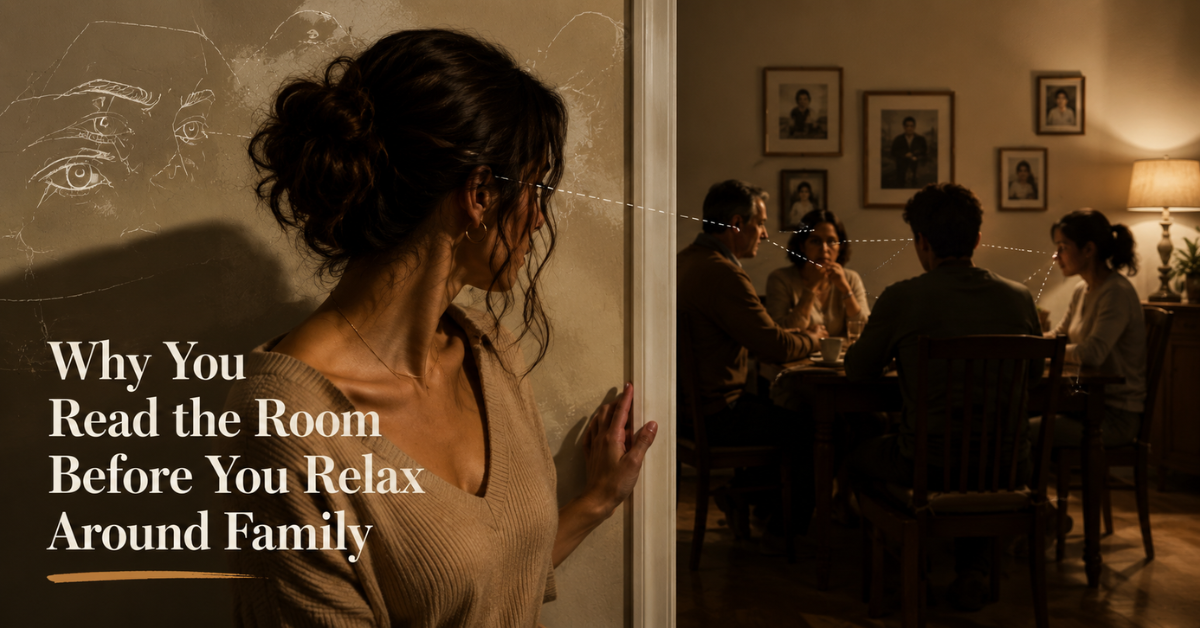
Some people never settle when their family is around. When they walk into a room they start scanning. They notice tone, silence, facial changes, pacing, footsteps, pauses, and the emotional temperature of the room before they even know what they are feeling themselves.
Most people think this pattern is their personality, and it usually sounds like, “I’m just observant,” “I’m just intuitive,” or “I’m just sensitive.” But for some people, reading the room started as a way to stay ahead of what happened when the mood in the house changed.
In early developmental trauma, hypervigilance develops, which is an ongoing scanning that can continue even when the original danger is no longer present.
You may read the room before you relax around family because your body learned that subtle shifts in tone, mood, silence, or atmosphere mattered long before anyone said anything out loud. What feels automatic now may once have been protective.
Why do I instantly tense up when someone’s tone shifts around family?
For many people, subtle changes in voice, silence, or energy are early warning signs long before they had the words to describe what was happening. What feels small now may not have felt small in the room that trained you.
Small shifts can feel big when they once changed the whole room
A lot of people know this feeling: someone’s voice gets shorter, a pause lasts a little too long, a door closes a little harder and louder than it should. Although nothing dramatic has happened, their body has already started to tighten. Their stomach pulls in, the shoulders start to rise and part of you starts preparing for something.
This reaction can feel embarrassing. People can start telling themselves that they are overreacting, but if small shifts led to criticism, withdrawal, volatility, blame, or emotional whiplash, then the body now has a reason to treat those changes as significant. In those instances you are not reacting to “nothing,” you may be reacting to a pattern your nervous system learned to read very early.
Your body may brace before your mind knows why
One of the most confusing parts of this pattern is how fast it happens. You are tense before you have a thought. Your body knows before your story does. Your project framework is helpful here because it names that the body often responds before the story becomes conscious, especially when a pattern has been rehearsed enough times to become automatic.
That means the bracing is not necessarily irrational. It may simply be older than your adult explanation.
Why do I notice everyone else’s mood before I notice my own?
Some people learned early that tracking other people’s emotional state mattered more than staying connected to their own. When the room felt unpredictable, noticing others could feel safer than feeling yourself. That can leave you outwardly tuned in and inwardly disconnected.
Other people’s emotions may have felt more urgent than your inner world
In some families, your own feelings were not the most urgent thing in the room. The real priority was whether mom was okay, whether dad was in a mood, whether tension was building, whether someone was about to shut down, explode, criticize, or withdraw. When that is the environment, your attention naturally moves outward. You learn to notice who is off before you notice what is happening inside you.
Over time you can read the room with stunning accuracy and still feel foggy about yourself. You know when someone else is irritated, disappointed, distant, anxious, or emotionally unavailable, but you need extra time to figure out whether you are sad, angry, overwhelmed, hurt, or afraid. That is not because you are shallow or disconnected by nature. It may be because your internal world had to stay secondary to the room.
Staying ahead of the room can feel safer than being spontaneous
Spontaneity is hard when you rely on being able to predict what’s next. If part of you is always asking, What is happening here? What is coming next? How do I keep this from turning? then being free in the moment becomes difficult. You are not just present. You are managing possibility.
That is why some people feel least natural around family. They are not entering the room as themselves first. They are entering it as a scanner.
Why does family make me anxious even when nothing obvious is happening?
Sometimes the nervous system reacts to subtler cues like tension in the air, a certain silence, a familiar facial expression, or just the general sense that everything could change at any moment. Your body may still be reading old risk even when the room looks calm.
Calm on the surface does not always feel calm in the body
This is one of the most painful parts of family-triggered hypervigilance. The room can look technically fine. No one is yelling. Nobody is openly fighting. Nothing is obviously wrong. And yet you still feel keyed up, restless, slightly sick, or like you cannot put your guard down.
That happens because “nothing obvious is happening” is not the same as “my body feels safe.” If your nervous system learned that danger often arrived through subtle escalation rather than clear announcement, then calm can feel suspicious instead of reassuring. You may stay on edge not because the current room is objectively chaotic, but because your body does not trust appearances yet.
Subtle family cues can still wake up old danger
There is a thing called defensive orienting. Defensive orienting is a state in which our attention narrows and scanning starts. This state also recruits our vision and hearing to locate what might be wrong. That maps closely onto the lived experience many people have around family: eyes scanning faces, ears catching tone, body bracing before the mind names a threat.
So when you say, “Nothing even happened, but I still felt anxious,” that does not automatically mean you imagined it. It may mean your body was reading cues that were once important, long before your mind had language for them.
Why do I notice one little change and instantly feel it in my body?
Many people become sensitive to small changes because small changes used to matter. A sigh, a pause, a sharper tone, a shift in someone’s face, those things may have meant tension was coming. Blame was coming. Someone was about to pull away, explode, shut down, or make the whole room feel different. So even now, your body may still treat those little signs like they are important, because at one point, they were.
What looks small now may not have been small back then
This is what people around you often do not understand. They think you are reacting to “just a tone,” “just a look,” or “just a pause.” But for a child who grew up in a house where little changes signaled bigger emotional weather, those things were never just little. They were previews.
Small cues can carry a lot of history. A small sigh once could’ve meant deeply painful criticism is coming. A pause can mean someone is about to disappear emotionally. A shift in the room can mean it is getting colder. And before you even think about it, your body may start adjusting. Get quieter. Get nicer. Get smaller. Get funnier. Become more useful. Be less visible. When that happens enough times, your body stops treating subtle cues as subtle.
Noticing fast may have helped you stay ahead of what came next
Fast noticing is often the nervous system’s way of trying not to get blindsided. If your body learned that preparation softened impact, then quick detection became useful. That is part of why what looks like “overreacting” is often better understood as “over-preparing.”
CBT describes hypervigilance as a scanning process that keeps threat cues highly salient and can make ambiguous signals feel confirming. In plain English: once your system gets good at noticing possible danger, it tends to keep doing it.
Why do I feel exhausted after family time even when nothing “bad” happened?
Reading a room is hardwork. Tracking tone, scanning mood, and bracing before anything even happens drains a nervous system even if “nothing” happened after spending time together. You can leave family time tired because your body never fully relaxed.
Preemptive bracing can wear you out even in quiet rooms
A lot of family exhaustion is invisible because it does not come from obvious drama. It comes from readiness. It comes from staying prepared. It comes from holding one part of your mind and body just alert enough to respond if the mood shifts.
These all costs energy and it is exhausting to keep listening and bracing your body. It is exhausting to keep translating silence, faces, pacing, and tone. It is exhausting to never fully sink into yourself because some part of you is still turned toward the room.
Scanning for what might happen can be as exhausting as reacting to what does happen
That is why family time can wear you out even when everyone was “fine.” Your system was still working. You were still reading, checking, adjusting, anticipating, and bracing. Nothing exploded, but your body never got to fully stop monitoring for the possibility that it could.
And that kind of tiredness is real tiredness.
Why do I relax faster around other people than around family?
Many people feel calmer with friends, coworkers, or even strangers than with family because those people are not carrying the original emotional weather signals. Family often holds the first room your body had to learn to read.
Other people do not carry the same old cues
There may still be anxiety with other people but the history is usually what’s different. Their silence is not the same silence that you grew up with. Their tone is not that specific tone. Their disappointment does not hit the same old place. So your body has fewer reasons to prepare, scan, brace, or get ahead of what might happen next.
That is why some people feel like themselves outside of their family, and it leaves them confused. They can be grounded, funny, creative, direct, even peaceful with people who know them less well. Then family contact happens, and suddenly the old weather system comes back online.
Family can pull the old job back online fast
Family often has that effect because it is not only a set of people. It is a relational environment with decades of stored meanings. Furthermore, our body remembers the different jobs it must do before the mind remembers the story. One look, one voice, one silence, one old dynamic, and the scanner wakes up.
So if you feel calmer with strangers than with your own family, that does not automatically mean something is wrong with you. It may mean those strangers are not carrying the same old assignments.
Why do I keep telling myself I’m just too sensitive?
It is easy to blame yourself when you forget the pattern was once protecting you. It feels easier to call yourself dramatic, too sensitive, or hard to deal with than to admit your body has learned to stay alert for a reason. What feels embarrassing now may have been intelligent then.
Calling it personality can hide what the pattern once protected
A lot of people survive by turning adaptation into identity. “I’m just very sensitive.” “I always notice everything.” “I’m just intuitive.” “I’m just really good at reading people.”
Sometimes these things are true. But sometimes they are also the polished version of a harder truth: I got good at tracking weather because not tracking it once cost me something.
That shift matters. Personality language can hide pain. It can make the pattern feel unchangeable when it may actually be learned.
Sensitivity may be real, but the fear underneath it may have been learned
Some people really are highly sensitive. Some people really do notice more. But heightened sensitivity and learned fear can absolutely overlap. The issue is not whether your perception is real. The issue is whether your body has been carrying danger around it for so long that alertness became your default.
You may not be “too much.” You may be overtrained.
Why can’t I stop scanning even when I know I’m safe?
It is hard to stop because the pattern may not feel like a habit. It may feel like responsibility. If your body learned that paying attention prevented pain, conflict, or emotional fallout, then relaxing can feel riskier than staying alert.
The pattern can feel like common sense, not hypervigilance
That is one reason this pattern is so sticky. It does not always feel dramatic. It often feels sensible. Of course I need to pay attention. Of course I should notice that shift. Of course I should prepare. Of course I should stay aware.
When a pattern has protected you enough times, it stops feeling like fear and starts feeling like intelligence.
Letting your guard down may still feel more dangerous than staying tuned in
This is where many people get stuck. They do not only know how to be vigilant. They trust vigilance more than ease. Ease feels naïve. Calm feels exposed. Relaxation feels like how you miss the thing you should have seen coming.
So even when part of you knows you are safer now, another part still believes tuning out means getting caught off guard.
What is my body trying to protect me from when I read the room like this?
Hypervigilance often protects against more than obvious danger. It can protect against surprise, emotional whiplash, criticism, blame, withdrawal, or the feeling of being caught off guard. The pattern makes more sense when you ask what it once prevented.
Room-reading often protects against impact, not just conflict
A lot of people assume hypervigilance only makes sense in openly chaotic or abusive environments. But quiet family hypervigilance can be about anticipating subtler impact. Maybe you were protecting against coldness. Maybe you were protecting against shame. Maybe you were protecting against being blamed for the mood, surprised by a turn, or caught unprepared in a room that could change fast.
That is why the pattern can persist even if the danger was emotional more than dramatic. The body does not only care about visible threat. It cares about impact.
The pattern becomes clearer when you ask what it once saved you from
This is a better question than, Why am I like this? It opens the door to compassion instead of self-judgment. If scanning once protected you from being blindsided, humiliated, punished, frozen out, or overwhelmed, then the pattern makes sense. It may cost you peace now, but that does not mean it was useless then.
Understanding what it protected you from is often the first real step toward change.
What does healing from this actually begin to look like?
Healing usually starts when you stop treating the pattern as “just how I am” and start seeing it as a learned response. Once the pattern becomes visible, you can begin shifting from constant weather-tracking toward safer self-awareness, steadier boundaries, and new experiences of calm that your body can actually trust.
Naming the weather-tracking job changes the story
Once you can say, Reading the room was a job my body learned, the shame starts to loosen. You are no longer only seeing yourself as difficult, fragile, dramatic, or overly sensitive. You are seeing strategy. You are seeing intelligence. You are seeing protection.
And what is seen as strategy can eventually change in a way that what is seen as identity often cannot.
Learning your own signals matters as much as reading the room
Part of healing is turning some of that attention back inward. What am I feeling right now? What happens in my chest when I hear that tone? What story do I tell myself when the room changes? What do I need when I start bracing? What part of me comes online first?
That is a big shift for people who spent years reading everyone else before reading themselves.
Safer relationships can teach your body what settling feels like
The body learns through experience. It needs repeated moments of truth without punishment, closeness without volatility, difference without collapse, and presence without having to pre-scan for harm.
Your framework is useful here because it says symptoms are organized strategies and that change often requires new relational experience, not just explanation.
Calm becomes more possible when alertness is no longer your only skill
The goal is not to make you oblivious. It is not to remove your sensitivity. It is to help your system learn that weather-tracking is not the only way to stay okay. Alertness can become one option instead of your full-time job.
Conclusion
You may not read the room before you relax because you are dramatic, difficult, or naturally overreactive.
You may do it because your body learned that subtle shifts mattered.
What you call sensitivity may have been training. What you call overthinking may have been vigilance. What you call intuition may sometimes be a nervous system that got very good at tracking weather before it learned how to rest.
And healing often begins when you stop asking, “Why am I like this?” and start asking, “What taught my body that it needed to know the room before it could breathe?”
FAQ
Why do I instantly brace when someone’s tone changes?
For many people, tone shifts became early warning signs long before they had language for what was happening. Your body may still be reacting to old meaning, not only the current moment.
Is reading the room a trauma response?
It can be. In some cases, constant mood-scanning is part of emotional hypervigilance, especially when a person learned early that subtle shifts in the room mattered.
Why does family make me anxious even when nothing bad is happening?
Because your nervous system may still be reading subtle cues as old risk, calm on the surface does not always feel calm in the body.
Why do I always scan other people’s moods?
Some people learn that other people’s emotional states are more urgent than their own. Over time, that outward attention can become automatic.
Why do I feel exhausted after family visits?
Because scanning tone, mood, silence, and tension takes real energy. You can leave family time tired, even if nothing obvious went wrong.
Why am I calmer with strangers than with family?
Strangers often do not carry the same old emotional cues, roles, and learned predictions your body associates with family.
Am I too sensitive or hypervigilant?
It may be both and not in the way you think. You may genuinely notice a lot, and some of that sensitivity may also have been sharpened by the need to stay alert early on.
How do I stop reading the room all the time?
Usually not by forcing yourself to ignore what you notice. More often by understanding what the pattern once protected, learning your own signals, and building enough safety that your body does not have to stay on constant weather-watch.